Thursday, August 9, 2018

So, Exactly Why Do I Have to Have a Sound Signal on my Pleasure Boat?

Image result for boat whistle


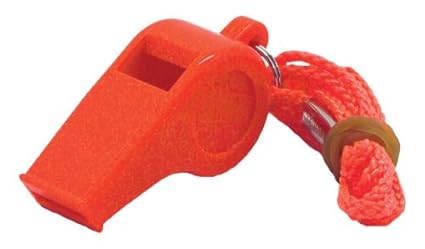
If you climb aboard most any small boat you will see a whistle attached to the keychain, or a horn stowed within reach of the wheel or tiller. And of course, you may have a horn installed by the manufacturer. Many of us know we have to have that gadget on board, but some of us aren't really aware why it must be there.

As I wrote in a previous post, sound signals are "required" to be used when navigating near other vessels - meeting, crossing or overtaking and within 1/2 mile. Inland rules say that we should signal intent, and the other vessel should answer with the same signal if in agreement or give the danger/doubt signal (4 to 6 short blasts) if in disagreement
In 29 years of boating on Savannah's waterways, I have never heard this occur. If you blow a whistle at a boat in Turner's creek they will probably wave or flip you off.  Inland rules also allow a radio exchange instead of sound signals when operating near other vessels, and I have occasionally heard this occur between vessels headed up and down the Atlantic Intercoastal Waterway (the ICW). Many small boats don't even have a marine VHF in operation... Ships in the river don't talk on channel 16.

But there IS a time when that whistle could prove to be very important to you. Imagine that in the spring or fall you elect to run over to Daufuskie Island for the afternoon, or out the sound to one of the barrier islands. When it's time to return to Savannah you discover that a big temperature differential between air temperature and sea temperature has created fog - often advection fog in the Savannah area. You need to get home, but you can't see much.

Can you legally proceed? Yes, within limits. You must slow down! You must listen for an approaching vessel forward of your beam - and the idiot coming up behind you blind and fast. And of course, you must be on the lookout even though you can't see much. That whistle hanging on your keychain? This is when you are going to blow that whistle - a "prolonged blast" of about five seconds - HARD - every two minutes. This is when you are underway and making way. (making wake). If you stop and are not tied to a dock or anchored, you are still underway but not making way. Now you offer up two prolonged blasts every two minutes.

"Hey, I am out here and not moving!"

Now, don't stop in the Savannah River in fog, because if a ship happens to be coming up or down the river, they may not hear your whistle and probably can't stop or turn if they did. Ships in the river in fog WILL be blowing big horns and/or sounding bells. Listen for them.

You can proceed at a slow speed, say five or seven knots, eyes and ears open, making your sound signals with your whistle or horn, and keeping up with your progress on your GPS. (You do have a GPS if moving in fog, right?) If you do happen to have a radio, this also might be a good time to self-announce your position and intentions on it. Be brief and to the point on channel 16.

And don't forget to turn on your lights...

Here is the Coast Guard's set of rules on their site...

Monday, July 30, 2018

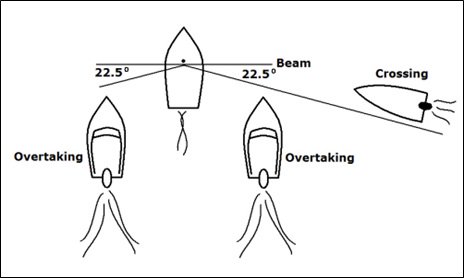
When does Overtaking become Crossing, and what does that mean to you in your boat?

Image result for vessel overtaking or crossing
A picture is worth a thousand words...

If you are overtaking, you are the give-way vessel. Always. Even if you are under sail.  If you are crossing, and are to another vessel's "right," you are the stand-on vessel. (The term "right-of-way is not used)  If the crossing vessel was on the opposite side in the picture above, he would be the give-way vessel.

It's important for a novice boater to understand basic concepts, such as "stand-on vessel," "give-way vessel," and "overtaking" versus "crossing" vessels. When I am forced to organize my thoughts to coherently explain something to someone else, it increases my personal level of understanding and helps me better apply what I know to the real world.

Next time you are on a boat, explain crossing, overtaking, and meeting head-on to someone along for the ride with you. Boating is archaic, with archaic terminology such as "abaft the beam." These terms need explaining. The act of doing this will benefit you and your listener.

Image courtesy Ace Boater training


If you are approaching another vessel at night and are in a position to see her red side-light, it means that you are the give-way vessel and must pass behind her. 

You should alter course and speed to avoid crossing in front of that vessel unless your paths will keep you more than a half-mile apart. 

If, on the other hand, you see a green side-light shining at you from another vessel's right (starboard) side, you are the stand-on vessel. The plan is for you to maintain course and speed in your vessel.

Be prepared for the other boater to not understand the navigation rules and not behave correctly.

That captain may not see you, he or she may be drunk or drugged, or maybe it's a case of "just plain dumb."

On Monday last, I was training two FBC members on a 28-foot twin. As we idled through the Thunderbolt no-wake zone another small boat approached us head-on. We altered course to the right and he turned in our direction. The captain had a group on board and was showing them the condos on the bank. No one on that boat was watching where they were going, and when he finally saw us, at about 50 feet, he was visibly startled. He waved at us sheepishly as he passed. 

Don't be that guy. Don't get startled or worse. Even though almost no one uses sound signals when meeting other vessels, we should have. A one-second blast of my horn or whistle would have been my signal of intention to alter course to the right. And it would have alerted him to our presence.

As the stand-on vessel in a world full of know-nothing boaters, you may have to alter course or reduce speed to prevent a collision. There's a collision-regulation (COLREG) for that too. It says don't crash. If it's chaos on the water and there are boats in all directions, slow down. If there is going to be a collision, watch it from a distance.

Okay, so what happens when you are right on or very close to that 22.5-degree line abaft the other vessel's right beam (side). Are you now overtaking and responsible to alter course and speed to give way? Or are you in a crossing situation and the "stand-on" vessel?

The most conservative response rule works here. If not sure whether you are the give-way vessel or the stand-on vessel, be safe and give way by reducing speed and/or changing your heading to avoid colliding.

How many times you have ever heard a small vessel give or return a sound signal on the water, as required by inland nav rules. That's one of the reasons you need a sound signaling device on hand, such as a whistle. 


When Fog Forms...

 This is the time of year when fog forms on the waters. Any significant difference between air and water temps makes fog likely.  So let...